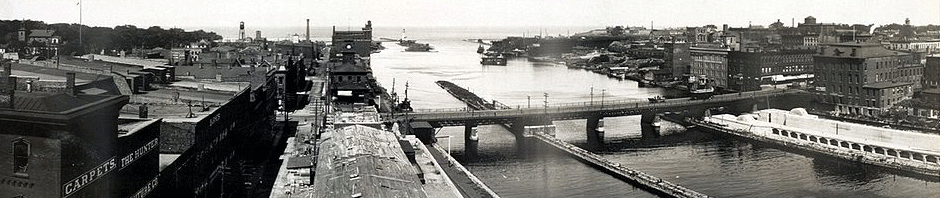
Oswego was granted a city charter in 1848 but has been an important part of the development of New York State and the United States of America from early colonial times. Its location on Lake Ontario provided one of the few easy to manage natural passages to the heartland of America. British colonials seeking to move into the interior of North America found the Appalachian Mountains to be an imposing obstacle. Overland transportation in those days was difficult, enormously time consuming, and expensive. They soon realized that by using the Hudson, Mohawk, and Oswego Rivers they could gain access to the Great Lakes and penetrate deeply into the heartland of America. Early on this meant opening up a lucrative fur trade on the frontier and fierce competition with the French who had long enjoyed a water route via the St. Lawrence River. Oswego became a pivotal site and the French and British fought over its control until the British finally won out in the French and Indian War. During the American Revolution the lakeside community also proved valuable in helping to thwart British forces moving against the Americans at Saratoga. Having won independence the Americans were free from the restrictive regulations which had hampered westward movement. Oswego’s port gave Americans an opportunity to ship salt from Syracuse to mid-west ports and, in turn, import western grain which was milled in the port city. Oswego became a boom town.
By the mid-nineteenth century Oswego’s population had grown from a single wilderness fort to one of the 100 largest cities in the country. Agriculture, shipbuilding, and commerce were the main movers taking advantage of the waterways which now included the Erie Canal system and various dams which harnessed the water power and made navigation safer. But, the coming of the railroads proved to be a dubious blessing. First helping to grow the local economy, they eventually negated the need for a water passageway west. No longer could one walk across the river by using boats which were moored so closely together. Oswego responded to the loss of commercial traffic by becoming an important industrial community, the home of such manufacturing giants such as Kingsford Starch and the Diamond Match Company. Many immigrants filled the demand for labor in woolen mills, malt companies, and railroad shops. By then, Oswego’s population reflected the American people of the country as a whole: the masses of Europe, first from the North and West, then from the South and East. They brought with them changes in food and challenged numerically the Protestant dominance of the city’s churches. Though many African-Americans have never concentrated themselves in the port city, Oswego offered slaves an opportunity to escape to Canada using its underground railroad. Some of those sites can still be identified. As the twentieth century moved on, manufacturing companies moved out.
Today, Oswego is a center for higher education (the home of SUNY Oswego), nuclear power (three such plants), fishing and boating made possible by its modern marina facilities, and tourism featuring the Marine Museum, the Richardson-Bates House, and Fort Ontario as it was in the Civil War era. Of special interest, there is the role the Fort played in being the only wartime haven for World War II refugees, which can be viewed at the Safe Haven Museum located in Fort Ontario.
The future is yet to be written. One bright sign is the resurgence of shipping activity at the Port of Oswego Authority. Workers are kept busy at the port handling shipments of windmill parts, many varieties of grain, aluminum materials, salt, asphalt, and cement to name the most common products. It is a growing states and international trade that augurs well for Oswego.
I am trying to locate information on the Netherlands Dairy and also on the book “The Haven (?)” that was about the Jewish refugees who stayed at the fort in Oswego after escaping from Germany. Any help would be greatly appreciated. Thanks.
Jody – the Rivers End Bookstore in Oswego believes the book “Haven” (by Ruth Gruber and David Sobel, Three Rivers Press (NY)) is currently out of print. However, Amazon has some used copies for sale, last I checked. In regards to the Netherlands Dairy, if you could tell me specifically what you want to know, I will do my best to get that information to you. Thanks for visiting.
Hi Jody,
I believe Netherlands Dairy was purchased or had a bottling arrangement with Crowley Dairy in the 1960s.
I grew up in the dairy business and remember the name. Crowley also bottled Gillespie Dairy milk for awhile. I think we even took over some of Netherlands milk routes.
Maybe this will help. Syracuse Netherland Dairy was the parent company of Oswego Netherland. They were the biggies in both citys for many years. Oswego Netherland was a couple of blocks west from the Friendlys Ice Cream place out in back and on the same side of the street. That was the Netherland Plant in Syr. were we picked up our milk.
They sold out to Crowleys (Binghamton) but Crowleys didn’t want the Oswego retail and whholesale routes or the North Routes so they turned them over to Gillespie Dairy. You can Google Syr. Netherland Dairy.
If you want more info.
We have a silver, pedestal bowl with the inscription “LITTLEJOHN from the citizens of Oswego”. What is this bowl and how does it fit into Oswego history? My wife’s great grandfather was the pastor at Christ’s Church in Oswego from 1906 through 1924.
Thanks for any information about the bowl.
My great-grandparents owned Brennan’s Bar on Erie St. in Oswego. Does anyone have any information / pictures they would like to share about this establishment?
My several great grandfathers owned various business in Oswego. Their names were Hooper C. Sharpe (H.C. Sharpe) and Jasper N. Moulton (J.N. Moulton). Some of the business names were, Sharpe and Bryant – Tobacco Works around 1850, Palace Drug Store (maybe 200 West 1st St), HC Sharpe and Co (19 East Bridge & 91 East First St.). Does anyone have any picture, references or other information? I am originally from upstate, NY around Ithaca and went to school at Oswego State and now reside in SC. Many thanks.
Anyone have information on the Baldwin family & shipbuilding in the 1800s? Thanks! D
Kingsford Starch Company had a musical band at one time in the 1880s-1900s–any photos of my great grandpa, the conductor/clarinetist, Thomas Clare (Clarey or Cleary)? A second cousin said she once saw a photo of him in a local Oswego historical book as he was leading a marching band either in a parade or in a concert outdoor….I only wish that she could have copied the photo for us…(my mother Helen Lavenburg Hunt , now age 91, lived in Scriba 1920s-1950s….anyone remember?) Thanks, Dolores Hunt Ozdemir
Dear Don Gillespie,
My gather owned Flack’s dairy. Did you know him? I was just googling Oswego history and came across your blog posts. My mother remembers Netherlands. When you say you grew up in dairy business and you picked up routes, did you ever take over routes of Flack’s dairy when dad closed it? Dad recently passed away last yr November 2011. Mom recognizes your name and said Dad knew you? Mom is Joan Flack (Joan Mahaney)
I think he sold it in 1966 to a man named Norm Peas?
What about Krul? Sivers? Both I think came to dads dairy when they closed.
Any other history you know of online that you perhaps have come across Flack’s dairy, I would appreciate the intel at jflack99@gmail.com
Every yr we go to Oswego a few times a yr, and go to our Flack’s camp at Fair Haven (Big Red House on top of Hill near park) and I always look to the left on RT. 104 when we go by where the farm was (opposite of Rudys)
Also, if you still live in NY, if you know of any place I can purchase old flack bottle memorabilia that would be great.
Thanks for reading.
I hope to correspond with you.
Jeff Flack
Rochester, NY
I am looking for information on the Lennon family of Oswego from the 1840s to 1940s…
My GG grandfather Captain William Lennon was a shipmaster on the great lakes and built his own home in 1860 at 197W Seneca St. (which sadly I heard was torn down). They raised 7 children. William also served in the Navy during the Civil War. Any information about the Lennons would be greatly appreciated. I will be visiting Oswego in a few weeks.
I am looking for any information about records from the Oswego Orphan Asylum in the 1870s. My great grandfather, Alvah Flannigan, was there and is listed as being 11 years old when the 1870s federal census was taken. Is there anyone who knows where I might find information about the orphanage and any records that might still be available about the ophans at the institution?
Penny Shaffer
I am looking for any information about records from the Oswego Orphan Asylum in the 1870s. My great grandfather, Alvah Flannigan, was there and is listed as being 11 years old when the 1870s federal census was taken. Is there anyone who knows where I might find information about the orphanage and any records that might still be available about the ophans at the institution? Thank y
I am looking for any information about records from the Oswego Orphan Asylum in the 1870s. My great grandfather, Alvah Flannigan, was there and is listed as being 11 years old when the 1870s federal census was taken. Is there anyone who knows where I might find information about the orphanage and any records that might still be available about the ophans at the institution? Thank you.
I lived in Oswego for 40 yrs. I had friends who had tunnels in their basements and I know of a tunnel hole on the lake..I am inquiring about the history of Oswego and the underground railroad…can you tell me where to look?
I am looking for information on the Phillips of Oswego, New York. Eliza was my GGGrandmother died in 1917 – trying to find information on where she was born (possibly Canada). If any one has info or knows where to find info, please let me know.